

- Genetic counselling should be provided for the family to understand the implications, inheritance patterns and potential for recurrence in future pregnancies. This may useful both antenatally and postnatally.
Achondroplasia, investigation & management with neonates with suspected achondroplasia (1212)

Warning
Objectives
- To identify which initial investigations should be carried out prior to discharge from the NICU.
- To highlight the specialties to whom onward referral should be made in infants who have a clinical or genetic diagnosis of achondroplasia.
- To provide information on follow up for infants with achondroplasia and health surveillance in the first year of life.
- To highlight advice, resources, and support available for parents and carers of infants with achondroplasia.
Audience
This guideline is applicable to neonatal staff working with neonates in the West of Scotland managed clinical network. This guideline is intended to provide guidance on the investigation and management of babies born with suspected achondroplasia.
Achondroplasia is the most common form of disproportionate short stature, with reported incidence from 1 in 10,000 to 1 in 30,000 live births and affecting over 250,000 people worldwide. Achondroplasia is caused by a genetic mutation which decreases chondrocyte proliferation with consequent reduction in endochondral bone formation resulting in the observed proximal limb shortening. The main clinical features typically seen in achondroplasia are: disproportionate short limbs when compared to the trunk, macrocephaly with frontal bossing, and ‘trident’ shaped hands. Typical radiographic findings include squaring of the pelvis, ‘chevron shape’ on distal femoral epiphyses, and small vertebral pedicles. Diagnosis can be confirmed by genetic testing.
A genetic diagnosis is made by testing for a mutation in the Fibroblast Growth Factor Receptor 3 (FGFR3) gene, with 99% of cases being caused by a Gly380Arg substitution. Around 75% of children with achondroplasia are born to two parents of average stature, representing a de novo mutation. There are several complications associated with achondroplasia, including increased incidence of sleep-related disordered breathing, hearing loss, and narrowing of the foramen magnum. Parents should be given advice and information on these aspects, as well as other aspects of the development and care of children with achondroplasia.
Male charts
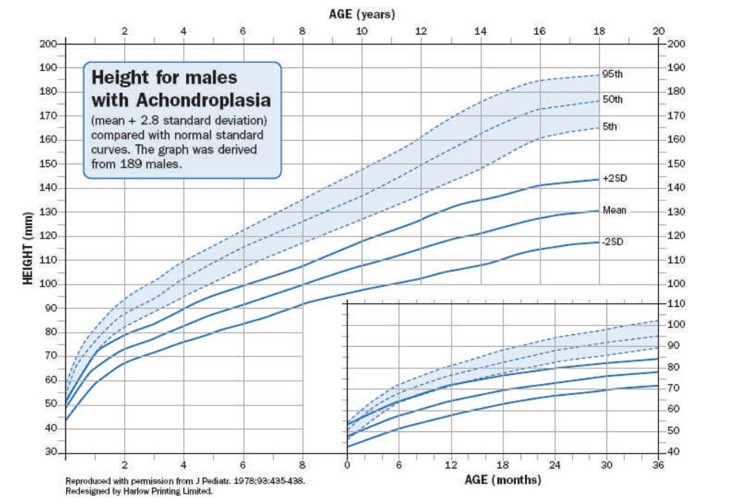
Height for males with Achondroplasia
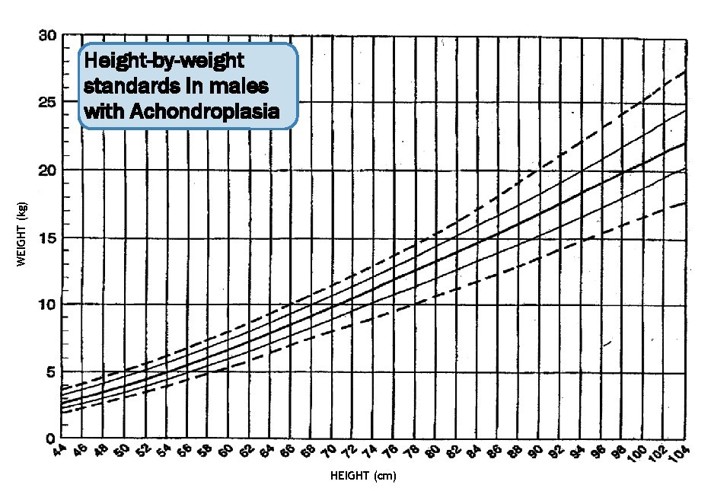
Height by weight standards for males with Achondroplasia
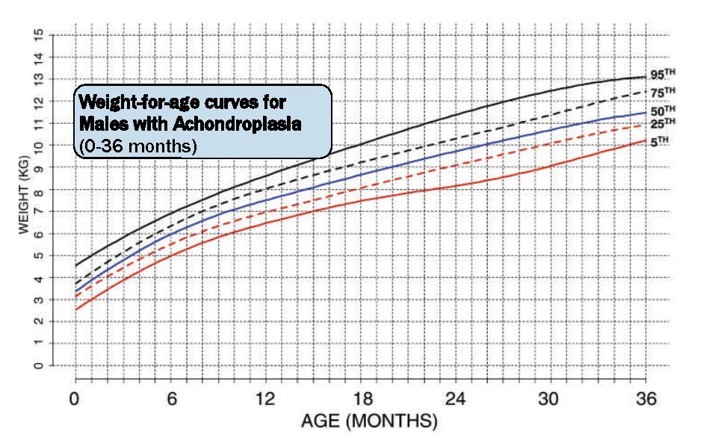
Weight for age curves for males with Achondroplasia (0-36 months)
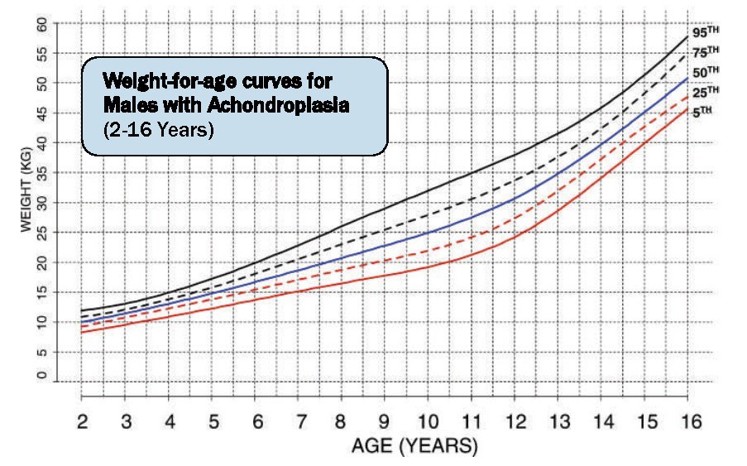
Weight for age curves for males with Achondroplasia (2-16 years)
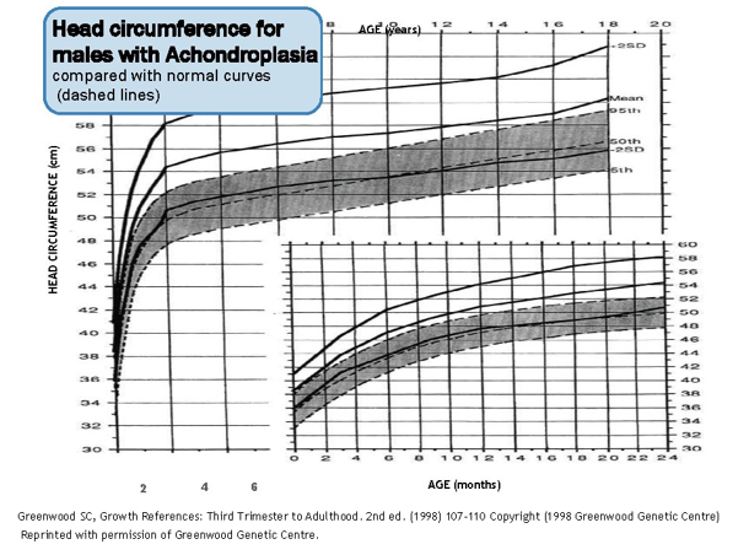
Head circumference for males with Achondroplasia
Female charts
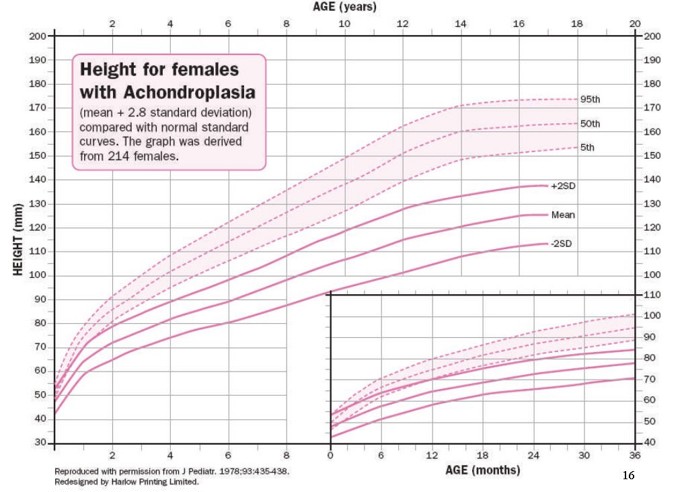
Height for females with Achondroplasia
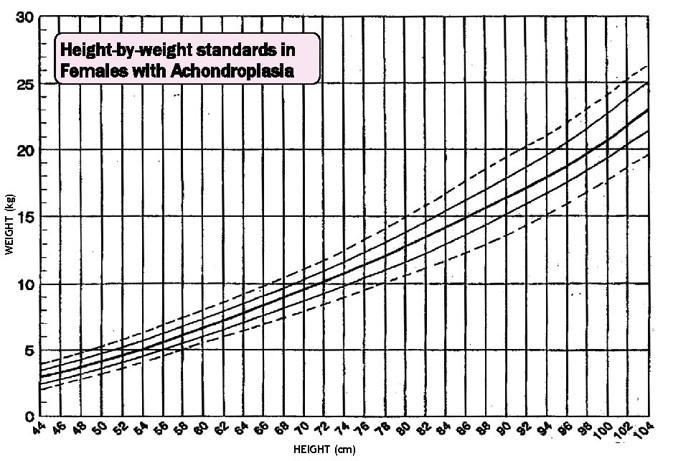
Height by weight standards for females with Achondroplasia
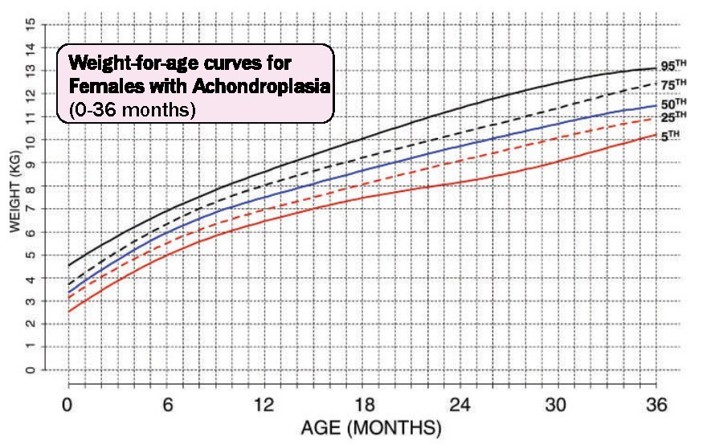
Weight for age curves for females with Achondroplasia (0-36 months)
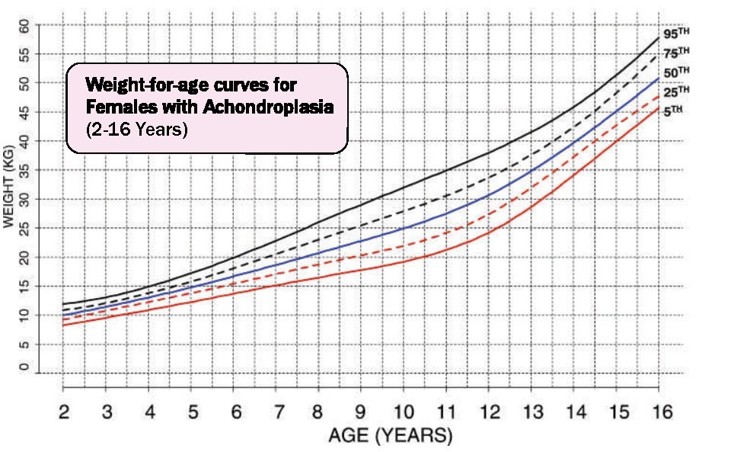
Weight for age curves for females with Achondroplasia (2-16 years)
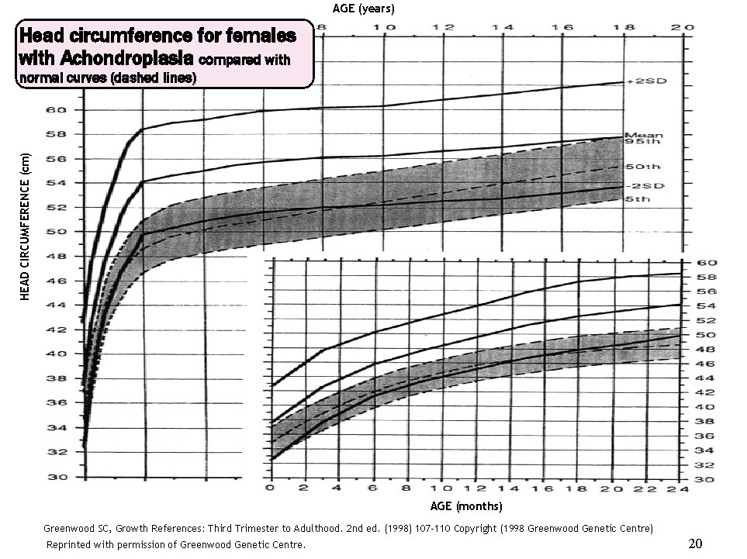
Head circumference for females with Achondroplasia
Height for males with Achondroplasia
Height by weight standards for males with Achondroplasia
Weight for age curves for males with Achondroplasia (0-36 months)
Weight for age curves for males with Achondroplasia (2-16 years)
Head circumference for males with Achondroplasia
Height for females with Achondroplasia
Height by weight standards for females with Achondroplasia
Weight for age curves for females with Achondroplasia (0-36 months)
Weight for age curves for females with Achondroplasia (2-16 years)
Head circumference for females with Achondroplasia